Showing posts with label travel. Show all posts

Wednesday, July 13, 2016

Sao Miguel: Lists

Making the most of a trip requires proper planning and research. I divided this post into three lists: research, advice and truths. Getting a general idea about the Azores is our first objective. Certain facts that we considered include:
  • Currency: Euro
  • Language spoken: Portuguese (and some English in certain tourist areas)
  • Seasonality*: 
    • Peak season: June, July, August, September and October 
    • Rainy/off season: January, February, March, October, November and December
    • Warmest month: August
    • Coolest month: February
    • Wettest month: January
    • Driest month: July
  • Temperature hi/low, not taking into account, the specific season: 12C - 25C
  • Precipitation: variable, even during the favourable months
  • Main industry: agriculture, dairy farming, ranching, fishing, tourism
  • Primary settlement/"capital": Ponta Delgada, Sao Miguel
  • Cell/mobile Service: available readily; will be roaming for most
  • Electrical outlet/plug voltage**: 220-240V (US/Canada are 110-120V); europlug
  • Crime rate: low
  • Socio-political situation: nothing of note, at the time we went except Euro-cup being a potential distraction
  • Tipping etiquette: tipping is not necessary but appreciated
  • Vaccines: confirm at least 4-6 weeks prior to travel. Other than being UTD on standard vaccines, it's recommended to get hepatitis B. Check the CDC or a local travel clinic for details.
  • Common phrases:
    • Good morning: bom dia
    • Thank you: obrigado
    • Good evening: boa noite
    • Hello/Hi: olá
    • Wash/bathroom: banheiro
  • Experience features:
    • Food and drink: particularly seafood/fish and beef/dairy and wine (from Pico preferred but from Sao Miguel is good too)
    • Nature/outdoor excursions: hiking, bird watching, golf, horseback riding, landscape scenery, snorkelling/scuba diving, boating, whale watching, surfing, yachting, paragliding, big-game fishing, gardens/parks, natural thermal pools, cycling, canoeing/kayaking
Advice based on personal experience include:
  • Dress appropriately; layers are your best friend--like light and medium weight merino wool shirts. Even visiting during the more favourable time of the year, we experienced ever changing weather, including intermittent rainfall almost everyday so it's wise to bring appropriate rain gear:
    • Back-pack/bag cover
    • Light rain coat/jacket with hood
    • Light weight wool socks
    • Good hiking/walking shoes that can keep water out and are comfortable
    • Umbrella
    • Water repellent pants (seriously--I wore these the most. Mine are cycling ones but it doesn't really matter... any outdoor clothing/supply store is likely to sell them).
  • Though we didn't do a lot of hiking or even walking, bringing folding hiking poles are helpful.
  • If you're up for it (and capable), see to schedule a horseback riding excursion (or two! And if you want to do more, check out Quinta da Terca or another equestrian facility) to take in the island's natural beauty by a different perspective. Some rides are planned at different locations like Lagoa das Sete Cidades.
  • A lot of excursions can be booked in advance, over-seas and generally make things less stressful but you can also do it when you arrive.
  • If you like to golf, do it! I was told by an avid golfer that there are some really nice greens.
  • Rent a car for transportation; while they have a public system, you're on vacation and it's just less stressful and you're likely to want to be able to pick up and go at your pace.
  • Google maps/GPS works well so add a roaming package and you may want to increase data as well, to one of the primary cell phone and the other(s) can tether by wifi.
  • Our primary communications back home was email and the roaming cell phone.
  • Credit cards are acceptable in many locations but travelling with cash is simply easier--especially at restaurants. Some financial institutions also require notification prior to travel so you don't get shut out of your credit card when you try to use it. How much euro you take depends on your habits. We took ~750 euros as we figure we'd be modest as often as possible but didn't want to get stuck and anything remaining would be squirrelled away for next time.
  • Whale watching scheduling can be a bit finicky. Schedule early in your trip so you have opportunity to reschedule as needed.
  • I should add that anything relating to a water (ocean) activity should be researched in advance because conditions can hamper or cancel your outings.
  • If you like the nature and science of things, check this listing for the various institutes that might be of interest.
  • Although there are 9 islands, each is different both culturally and with different features. For me, I wanted to visit the UNESCO World Heritage Sites (there are 2) but they were each on another island where travel was either costly or time-consuming for a single feature visit. If there is something specific, incorporate earlier so you can fit into your stay without doubling accommodations or otherwise.
  • You can budget food and water a bit by visiting local grocery stores.
  • Good souvenirs can be found all over the island but I wouldn't recommend the airport. Ponta Delgada has some good shops and places you visit, as well.
  • Try the fizzy Kima drink that is both made and bottled on the island.
+ADW enjoying Kima on one of the many occasions...

Some of the unusual or usual truths included facts such as...
  • Animals all have a job here. They are generally not companions of leisure. For example, if you're horseback riding for fun, you'll get a few looks from the locals.
  • Roads are twisty, narrow and thrilling. Drive safe and enjoy yourself.
  • Food and drink is great value for the quality and quantity so enjoy.
  • Tap water is generally not potable; usually bottled water is provided/offered.
  • Flora is lush, green and amazing everywhere and the views are breath-taking.
  • The most commonly planted flower (that thrives across the island and is often considered the official flower) is the hydrangea but it is not native to the region.
  • There are no natural 'top' predators on the island.
  • A lot of the flora/fauna is endemic to the region and being threatened by invasive species.
  • English language knowledge is generally serviceable but be prepared for the occasional non-English speaker.
  • Weather changes on a dime... one minute it's sunny and clear and the next, you're caught in a down pour or thick fog.
  • Portuguese people make mouth-watering gluten-y bread products *drooling*
  • The airport is small; nothing like Pearson or O'Hare but well laid out in my opinion.
  • Beach consistency range from fine sand to chunky (and sharp) volcanic rocks.
  • There is plenty to keep you busy for a week, at a leisurely pace.
These lists are pretty exhaustive but I doubt they're absolute. Hopefully they'll give you a good idea of what to consider if you're planning on visiting!

Sources
*Information from Weather and Climate
**A good website I found online for voltage/electrical plugs includes images
A tourist information website called Visit Azores is really helpful
TripAdvisor is a valuable source for information from other travellers

Monday, July 11, 2016

Sao Miguel: Culinary Highlights

When travelling, I make it a point to immerse in the culture through food (and drink). In high school a Portuguese classmate joked that their Canadian cousins must be Newfoundlanders because of their shared love of seafood. While most of us are familiar with fish, various shellfish and crustaceans, the introduction of sea limpets was the highlight of my seafood experience. These molluscs have a texture between calamari and mussels. Azoreans eat them raw as well as cooked; we had 'em grilled with butter, garlic, wine and spicy chilies with a squeeze of lemon. While it's no surprise that seafood is a staple of the Azorean diet, the other (that was a surprise to me) is beef and dairy.

On-site milking done in the fields and a cow in pasture
Most of the cattle raised is exported and they make A LOT of cheese. Every restaurant features fresh white cheese and Sao Jorge cheese as appetizers; one custom we were not familiar with before dining in Sao Miguel is that upon being seated, the server brings a plate of cheese (generally the fresh white one kind) and spicy sauce with bread--whether you ordered it or not. If you're not going to consume it, I'd recommend you tell them that, before being seated or it'll be added to the tab.

The countryside is intensively sectioned into walled plots of mixed farming, by lava stone, ranging from small residential gardens, to beef/dairy farming, to pineapple or passionfruit "orchards". Driving around the island, it is common to see holstein cows grazing on the sides and tops of hills as well as people's front yards. But as history has it, the original major agricultural export was oranges, until a disease wiped out the island's crop. Wine grapes are another crop grown but the best wine in the region is that from Pico Island. Another notable super drink cultivated is tea, with two plantations still active: Porto Formoso and Gorreana, from the inception of the cultivation in the 1870s. Gorreana is a functional museum where visitors can learn about the process and sample the tea.

Tea fields of Gorreana
Dining in Sao Miguel is quite the experience and you will not be disappointed. My most memorable meal is the Caldeirada de Peixe (and my mouth waters reading the linked page describing the dish in all its amazingness) at Restaurante Mariserra in Ponta Delgada. Yes, we are wearing bibs; be fore-warned not to wear any light coloured clothes or you'll be redecorating that shirt.

Restaurante Mariserra
The first meal of the stay was a little less memorable but one we still enjoyed: a steak sandwich and fries, and fried sardines (*yum*) at a cute hotel Solar do Conde near our own hotel. This was our first exposure to beef on the island and it was really good so expectations were high.

Hotel Solar do Conde
The only place on the island that topped our beefy expectations, was the farming coop (Associacao Agricola de Sao Miguel) which also has a restaurant on site, open to the public. We enjoyed our meals here so much that we went twice and both times, it was a full-house. The signature dish is the Portuguese steak: a fried steak with an egg on top. An unusual combination was the blood sausage and pineapple but worth it!!

TravelAdvisor rates them high
Our first meal out on the town was at a Portuguese restaurant (and accommodations) in Ponta Delgada established in 1908, called Alcides. We over-did ourselves this time since we hadn't been informed about the cheese and bread custom. But boy did we enjoy ourselves! Conger eel stew and fish egg scramble/fry.

Fish egg fry/scramble and Conger eel stew!
Another specialty dish is cozidos. Foods cooked with the heat of the geothermal energies of the Furnas area. Pots of ingredients, generally meats, potatoes, vegetables and rice, are buried in the ground and then dug up several hours later. It was at Tony's where we first tried sea limpets accompanying the cozidos and deep fried forkbeard fish.

Cozidos in Furnas
Despite going out to explore different tastes, we did spend one dinner at the hotel we stayed, Pedras do Mar, and had a lovely night in, with a fresh salad, cod and grilled octopus.

A night in, at Pedras do Mar

We couldn't forget the best way to spend our lunch after horseback riding at a little seafood place by the ocean called Bar Caloura. This unassuming place took advantage of its location by the ocean and the catch of the day menu changed daily. You'd just pick a fish you wanted, they'd grill it up for you with access to the salad bar. Very relaxing and wonderful way to spend lunch after a ride.

A photo posted by Deborah (@my_examined_life) on

Food and drink is always such a highlight of our travels but being prepared for the trip is pivotal for a good experience. Coming up next, preparations and other thoughts about making the most out of a trip to Sao Miguel!

Sunday, July 10, 2016

Sao Miguel: Just Passin' Through

+ADW and I saw and did everything we could in Sao Miguel: we climbed mountains, braved the ocean, walked into the mouth of a (sleeping) volcano... Actually, the entire island is a series of lush volcanic craters so that doesn't really say much other than we're crazy and the people who choose to live there are even nuttier than we are! We stayed at an unassuming modern zen style hotel recently constructed on the north-western coast that boasts quite the facilities; few of which we bothered to get acquainted with--if we wanted spa services, we wouldn't have travelled so far for them.

The Azores boasts a variety of active excursions as well as those for the less actively inclined. For those wanting to get out and about, activities range from water to land and everything in between; there is certainly something for everyone; some of it seasonally dependant such as surfing. For those who are less inclined to trek into the wilderness (so to speak), you'll find that the food and drink is pure and unadulterated--fresh in a sublime sense--it still brings envy (and a bit of drool) to realize that this is the standard; as well, many of the island's landmarks or 'museums*' are easily accessible by car--something I highly recommend for one travelling in the Azores.

*I use this term broadly since I can't quite find the best word to describe places of scientific and historic exhibition, discovery and research.

Instead of organizing my posts in the typical day-by-day adventures I've composed previously, I figured visitors might not be limited only to Sao Miguel; after all, there are nine islands. We start with my list of top 5 must do areas/features for a shorter length of travel on Sao Miguel.

1. Lagoa das Sete Cidades
This is probably one of the most popular image in a Google search of the Azores. These two visually distinctive lakes, located in the western third of the island, are situated in the crater of the civil parish of Sete Cidades and attract visitors and locals alike, to take in the stunning landscape. It's a view that simply can't be captured on camera and I'd say, one of the most breath-taking views I've witnessed in person and there are many look-outs. The views are so amazing that someone thought to cash in on it by building a hotel (Hotel Monte Palace) that overlooks the lagoas but didn't take into account the view is only viable when it isn't covered in fog--which is often--and today, the hotel stands abandoned.

For those looking to head out into the wilderness on foot, day hiking around the lagoas is an excellent way to see the natural landscape. An alternative would be to contact one of the equestrian companies of the island to see if they have any tours on horseback.

Not far from the two lagoas, there are natural thermal ocean pools that are a great trip for (what I consider) the brave: Ponta da Ferraria. The link is quite extensive so I won't go into detail, but stress that this feature is VERY MUCH dependant on weather and time of day. Go at the wrong time and you may be dragged out to sea or smashed against the rocky shores. There is no admissions for the natural pools but the (safe) man-made ones charge bathers.

2. Furnas
For me, this was my favourite area to visit. Not just because there is volcanic activity and a clowder of friendly felines:

A photo posted by Deborah (@my_examined_life) on


Located in the eastern-centre of the island, Furnas features huge calderas, fumaroles, geysers and hot-springs throughout the civil parish. The region is also home to one of the top hotels in Portugal: Terra Nostra Hotel, styled in art deco fashion and built in the 1930s, to attract "monied" visitors. The hotel is also keeper to a stunning gardens ground that is a must to check out (charge admissions). On the other hand, if you don't end up staying in Furnas, you could spend a morning taking advantage of the mineral hot springs--something we didn't feel inclined to do (in this instance).

Instead, we wandered into the parks area of Lagoas das Furnas where we thought we were going to take a brief stroll around the park but discovered a research and monitoring facility of Furnas: Centro de Monitorizacao e Investigacao das Furnas. Much of the island has been heavily burdened by the increase in agriculture practices that put the indigenous flora, fauna and fresh water reserves at risk but the government is taking steps to right poor practices that threaten the unique environment. I highly recommend visiting, in addition to the gated garden (you can get combo admissions to both but just make sure you have enough time to do both and are dressed appropriately).

We also visit the parks where the locals utilize the unique geology to cook food, by volcanic activity: cozidos. At this point in our trip, I was missing my two fur-babies and it was as if fate just knew (as always), and the moment I stepped out of the car at the park, a tortoiseshell kitty happily trots towards me in hopes of getting a hand-out. It doesn't surprise me that stray cats decide to populate this area since it's likely they'll get a meal. There are several restaurants that feature this menu and we visited one of the most well-known: Tony's.


One place we didn't manage to fit into our schedule (and I REALLY wish we did) is the Microbial Observatory of the Azores because I am a proud microbiologist by education, indirectly through my various forays into home fermentation and by work (seeing as many diseases are caused by microbes).

3. Ponta Dalgada
Ponta Delgada is the largest, most populated municipality and administrative capital for the region. If you're looking for some souvenirs and have a little less than a day, you could check out Fort de Sao Bras:


and wander the main part of the city and pier area. If you're looking for a more adventurous excursion, make your way to the pier see if you could sign up for a whale watching outing. This is unfortunately, highly weather dependant and it's tricky to tell from land so if you want to do this, try to book it early and if you need to re-book, there's still time to reschedule. Unfortunately for us, ADW was quite the sad panda since we didn't have that chance to head out. #nexttime


4. Vila Franco do Campo
If you're a history buff, this one would interest you because while Ponta Delgada is the current "capital", it wasn't always the case. Vila Franco do Campo was the main settlement until October 1522 when a violent earthquake shook the region, causing landslides that killed more than 5,000 of the inhabitants--many who were buried alive. The area has since been re-settled but has never regained its prominence as being the primary "capital". That said, it's still worth seeing because from here, you can visit or view (depending on the time of year and your interests) a crater islet about 1km from the south shore with indigenous flora/fauna and a small crater lake where visitors can swim and snorkel.

Bottom of the chapel steps
As we discovered about the Portuguese, they are a religious bunch and one of the most incredible churches we visited is the Our Lady of Peace Chapel, where this chapel is situated high on the top of the hill, providing an amazing panoramic view for any who visit, along with the beauty of the chapel itself. Be prepared for a hike well worth it and don't look back/down until you get to the top so you can be wowed.

There is also a regional cookie/cake made here that is worth trying when you're wandering around and looking or a snack.

5. Nordeste
The eastern third of the island shows visitors a more raw and untamed section of the island--full of death-defying mountain side roads and what appears to be more of the indigenous flora and fauna. Driving out to explore this area is a driver's dream come true with narrow winding roads carved into the sides of the mountains or passing over deep forested gorges.

Farol Ponta do Arnel
A highly recommended stop over here is the lighthouse on the most eastern point: Farol Ponta do Arnel. It's a functional lighthouse that is occasionally open to the public (usually a Wednesday) and worth seeing. The hike down to the house is steep so be sure you're prepared with the right shoes, water, endurance and clothes (hiking sticks help too) because going down is one thing, but coming back up is entirely another. Pack a picnic and you can chill out near the parking lot before or after your visit.

One of my favourite things about the island is the various gardens and look-outs along the roads where you could stop to enjoy the view, the company and a snack. One of the prettiest ones we visited was Miradouro da Ponta da Madrugada.

Friday, May 27, 2016

ar·chi·pel·a·go: Azores

+ADW and I are off again! We've elected to travel to the Azores, a set of 9 green volcanic islands in the North Atlantic Ocean. The Azores are one of two autonomous regions of Portugal (the other is Madeira). 


The 3 main cities of the Azores are: Ponta Delgado, Angra do Heroísmo and Horto. All the islands are of volcanic origins but some have not had any recorded activity since being settled here. The first islands were discovered in the early 1400s during the Portuguese Age of Discovery (1415-1542) and helped settled by Gonçalo Velho Cabral. The islands' climate is mild and sub-tropical considering its northernly location but is affected by the Gulf Stream and location relative to continents. Temperature ranges are temperate ranging from 3-30C throughout the year with a distinct "rainy season". The main industry on the islands is agricultural in nature; São Miguel's current agricultural yields are dairy and beef, pineapple and passion fruit and Pico's wine is fantastic.

As any opportunity I have to travel, the top of my travel bucket list is to visit as many UNESCO World Heritage Sites as possible but the two in this area are on the islands of Pico (Landscape of Pico Islands vineyard culture) and Terceira (Central Zone of the Town of Angra do Heroísmo) but we won't be heading there this time... since there is already plenty to do and see on São Miguel.

Check in to see what we are up to, through the Instagram account and I'll be sure to give everyone proper updates whenever I have a chance to do so :)

Wednesday, August 5, 2015

Riding In Iceland

I received an email from a reader about my trip to Iceland and how I handled the disinfecting of riding equipment. I realized when I was responding, that I never actually posted any resolution about how I did handle this aspect of my trip. So, to help other equestrians who are thinking about going to ride in Iceland, I have a summary of what I ended up doing and some details I encountered while I was doing the research.

Note: as I did run out of time during my research, I wouldn't say my summary is complete but this should be a good start for those looking; my information is also specific for equestrians so anglers or hunters or vets need to do more research.


Background

Iceland is an island nation that has its own population of horses, called the Icelandic Horse. Their horses are not vaccinated against any seriously infectious disease. As like any isolated country, their biosecurity measures are meant to protect all their flora and fauna. Anglers, hunters and equestrians alike need to take appropriate biosecurity measures to protect the ecosystem during their visit.

Researched Options

When I spoke with my small animal vet, she told me that vets generally travelling to different animal populations practice 2 weeks prior and 2 weeks post travel, to avoid any contact with animals, period. That is a very general practice and wouldn't hurt to employ, if you can. But, I was never asked to do this for my travels.

Travellers can approach this requirement by two options:
  1. Prepare prior to travel: riding clothes like pants and tops should be wet washed and dried (or dry cleaned) and then "rested" 5 days prior to going. Boots and half chaps can be washed and dried and then further disinfected with Virkon-S or a similar disinfectant (you can probably find this at most tack shops). Then you can get your veterinarian to write up a letter, sign and stamp it to certify that you have completed as needed.
  2. Address the requirement upon landing in Reykjavik: if you want to do things in Reykjavik, you'll want to stay longer than a few days. There is a service available at the airport called Icepark. They can do all that stuff for you (they also do this for anglers and others) but hold things for a few days before providing them back to you. I didn't go this route and didn't further investigate it but it sounds like it could prove to be logistically challenging.

Limitations

There are limitations about certain items that absolutely cannot be brought into the country... such as used riding gloves and any used horse tack. The reasoning behind this seems to be that there is a high chance that these items would come in contact with equine fluids such as saliva etc so were simply prohibited to tourists to bring.

Keep in mind though, that Icelandic horses have their style of tack and plus, it's probably not possible to know the size of your mount. Gloves on the other hand are not terribly expensive so it likely isn't a major issue to get new ones for your trip.

What I ended up doing...

I didn't end up getting the veterinary certification that was referred to me because I ran out of time. I did have correspondence with a representative from MAST, the Icelandic Food & Veterinary Authority, as well as my small animal veterinarian. Because my trip was not solely focused on riding and I wasn't staying a long time (over a week), I did as simply as possible. I washed my riding clothes (as directed) such as tops and bottoms and then bought new gloves (I didn't have winter gloves anyway), and used the rest of their equipment when I got there.

Because of the amount of stuff to bring and the coordination that would be involved, I didn't think that doing more was worth my time. However, if your trip is more horsey focused or longer, you might feel otherwise.

Resources

Check out the MAST website (English version) and contact them to get more information. They are helpful but you'll want to do it well ahead of time so you don't run out, if you need more extensive information.

Bonus Tip

I found taking photos or videos was easiest with a mounted camera such as a GO Pro to keep your hands free during the ride.

Tuesday, July 21, 2015

Canadian Wild West, Part II

Half way through my post Calgary Stampede post, I realized that it was too long to make into a single post. If you did make it through the entire post, I commend you! It was long, even for me. Today, I finish up...

On day 4, we have the main attraction of the Stampede, the rodeo. This is an incredible show of athleticism of both man and beast. It's also amazing to see the cowboys jump on a bull or horse and just aim to sit on it for 8 seconds. The longest 8 seconds ever! I did pick up a few tricks about what to watch for when they're bucking those broncos or bulls! Not that I hope to ever have to use it... but first, lunch:

Jalapeno mini donut poutine (you read that right!)

ADW is a (Chicago style) hot dog connoisseur!
The rodeo takes place in the Grandstand--the same place as the chuckwagon races. They just corner a smaller section of it and it becomes a closed off arena of sorts. It is in the sun though, so we start out afternoon under the hot sun but are lucky that the sun is moving a shadow over us. The rodeo is amazing to watch. Our seats weren't too bad as we were on the second level. We watched the saddle bronc, bareback, steer wrestling, team roping, barrel racing, and bull riding. There was a kids event of riding the wild pony. I tell you, you'll die because it's so freggin' cute.

ADW even sat next to a real cowboy who was there to watch his grandson compete in the novice levels. He competed in his younger days for some roping type events and I think ADW had a really enjoyable time chatting with him. The rodeo clowns... those guys are hilarious. The commentator clown was just killing the audience with his sense of humour and antics. He was highly entertaining while twerking (yes, that's right) and dancing up a storm between competitors.

I could not say I was the least bit disappointed with the rodeo. It was exactly as I expected it to be! Unfortunately, I didn't bring my zoom lens so I didn't get any photos but you'd get the same impression when I went to the rodeo at the Royal in 2013.

------

To finish our trip, we made our way to Spruce Meadows. T was actually there (from the stable!) and she told ADW that earlier in the week, she was watch some serious eventing. I love Spruce Meadows because there's no admissions to get on the grounds and the grounds are just amazing. Every lawn and garden is manicured to perfection. The amazing thing I noticed too was that the arenas were not sand rings.. but grass rings! I can't even imagine the amount of maintenance that is required to groom the grass arena after a show. But, everything looks absolutely perfect. We watched some show jumping and visited the gift/tack shop during our leisure stroll around the grounds.

Welcome to Spruce Meadows!
Amazing grounds where even the non-equestrian can even appreciate

Sailing over the jump effortlessly

Always amazing to see the sheer power of the horses pushing
 themselves and their rider over the jumps

Needless to say, this vacation was exactly what I needed before I get back into the swing of pulling my life back together. I definitely returned well rested and with a clearer head. 

Monday, July 20, 2015

The Canadian Wild West

Welcome to the Canadian version of the Wild West: Calgary Stampede!

It's one of those events that you gotta add on your "do see/do" list just because it's so freggin' iconic; it's like Oktoberfest or the running of the bulls. Amb and I left Toronto on the 6th and with no plans for when we arrived, checked into our hotel, ate a late lunch and then headed into the city to check out the festivities. We are greeted by a lively, busy and festive feel populated with folk donning western apparel. Arriving in our very normal and very casual travel outfits, we made our way to Riley & McCormick to see if we could find something to help us mix into the crowd.

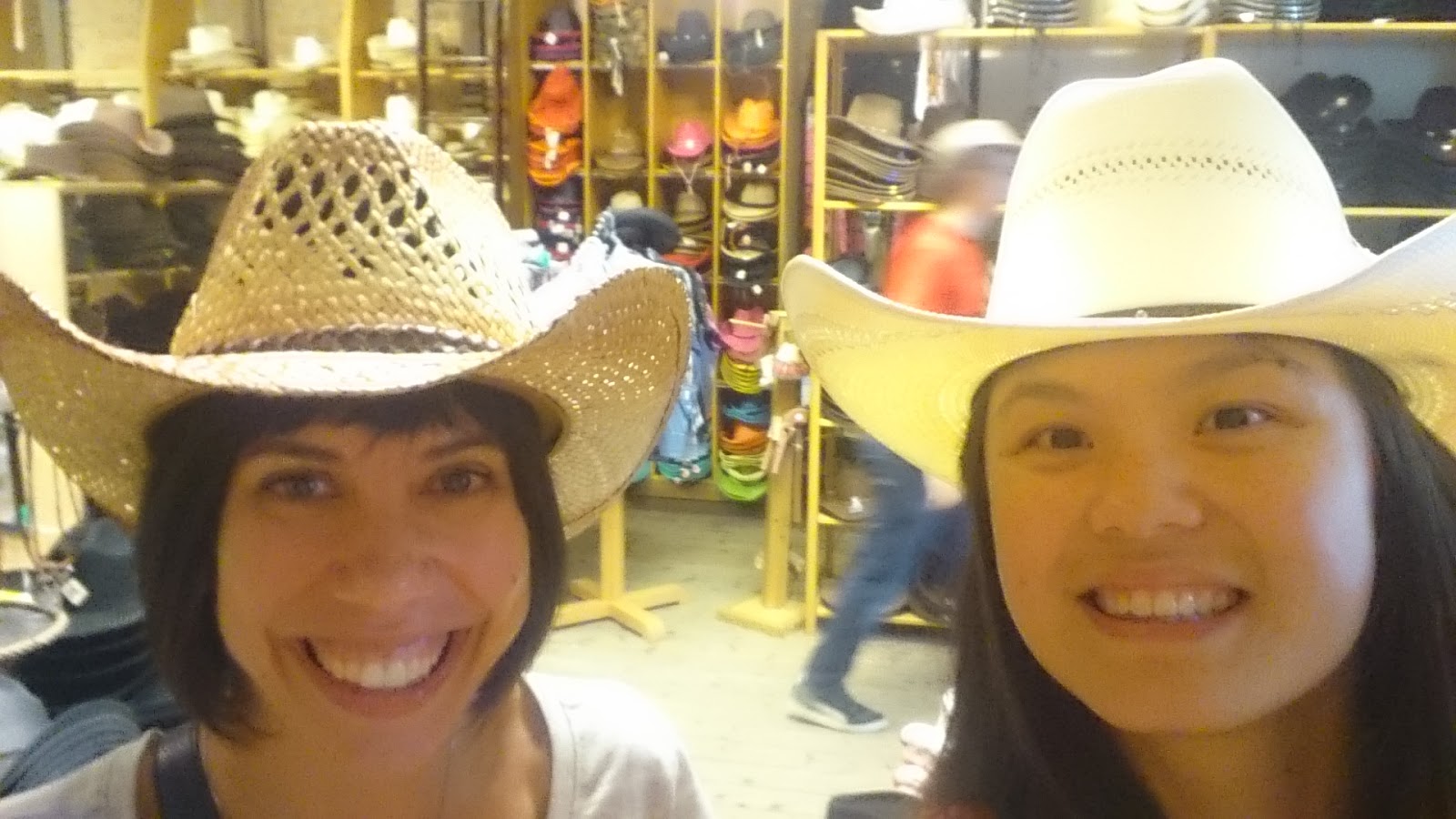
Getting cowboy'd up! YEEHAW!!

I suggest checking out R&M because their selection is SO extensive and there's something "fun" about it (they have a life-sized fibreglass horse out front that says, "I'm too old to be ridden!"). But seriously, they have a wall of boots and a wall of hats in different colours and materials. The price range is wide too, so don't be shy if your budget is modest and go nuts if it isn't!

That is a lot of boots... and I still only found one pair that I liked

Amb is excited to pick a hat for that lovely melon of hers!

At this point, +ADW is watching the rodeo and will watch the chuckwagon races in the evening because he's here for business (really, that's what he's here for!). We're left to our own devices and walk 8th Avenue SW because a portion of it is pedestrian fitted. We play a game of "spot the real cowboy" and make bets about which one of the cowboys we see strutting down the street is an authentic western cowboy versus the office folk and tourists who like us, are just playing cowboy.

As evening approaches, we are hungry and a little bored (it doesn't seem like many cowboys frequent the downtown) and make way to a place called the 'Palomino Smokehouse'. With our luck, a very inebriated young lady snuggles up to Amb while we're getting our IDs checked and the bouncer asks, "... is she with... you two?" To which we quickly quip, "no, no she's not!" Once she's shoed away, Amb nervously looks at the bar and then me and meekly asks, "are we still going in?". Oblivious to her apprehension, I boldly declare that we must because this place looks so authentic and ADW would so go. Plus, the bouncer has a friendly face while being physically intimidating so I feel comfortable. We spend the evening drinking (a little), snacking (a lot) and listening to live music by a local folk band named Sealegs who played with the Godfather of Yellowknife first and then went on set. They were highly entertaining and played a bunch of songs that Amb knew.

------

Moove on over to day 2 of our trip and we're getting ready for the evening chuckwagon races. We have lunch at the Calgary Tower to get up high and an impression of the city landscape. We have a little fun in the gift shop...
Amb getting fresh with Randy the RCMP Grizzly

ADW is always getting us into trouble...

ADW has found the hat that fits!

After lunch, we head to the Stampede grounds...

Hold onto yer hats!
Amb and I are prepared since we checked the guidebook prior, and circled the exhibits and events that interest us so we proceed to drag ADW around for our amusement...

The Ag building is full of fun exhibits for the whole family

This one's for Ariel!

Miniature donkeys like Jethro

Blacksmith demos. Point out the blacksmiths!

Miniature pony scratching him bum

Western cutting competitions

Piglet heap!

Driving demonstration

Nobody comes to Stampede without trying the food on the grounds:

Hot beef sundae

Pizza foot-long

ADW briefs us on what he's learned about the races as we're waiting and we are totally blown away:
chuckwagon racing is an equestrian rodeo sport in which drivers in a chuckwagon led by a team of Thoroughbred horses race around a track. It is a team event, led by a driver who commands a team of horses pulling the chuckwagon, and is supported by two or four outriders, each racing individual thoroughbred horses that follow the chuckwagon. Each race typically involves three or four teams, and begins with the outriders "breaking camp", by tossing two tent poles (with four outriders only) and a barrel representing a camp stove into the back of their wagon before mounting their horses and following the wagons as they complete a figure eight around two barrels before circling a race track. The first wagon to cross the finish line typically wins, although various time penalties are handed out for infractions such as a barrel being knocked over, a tent pole or stove not loaded, wagon interference or an outrider crossing the finish line too far behind his wagon driver. (Wikipedia)
There are 9 heats and the starts are madness. Try getting 16 thoroughbreds to make that figure 8 loop and then run around the track at top speed. There were a few mishaps and each race is not long. The surprise of the evening is the "evening show" that follows. Without expecting anything, we were totally blown away by the Canadiana routine that was put together. A stageful of dancers and singers all in costume and singing about... Canada! The show was fast paced and accessible for all audience members while being educational (I love getting schooled!). It also ended with a family being made Canadian citizens and a humongous pyrotechnics display. Go big or go home was certainly the point tonight.

-----

Day 3 was a quiet affair away from Calgary while Amb went to visit family, ADW and I drove out to Banff for a trail ride into the Rockies.

I love how small the Rockies make me feel, every time.

ADW loves those paints/pintos

I'm on a cuddly horse named Guinness

Taking this photo was precarious!

Mountain on one side, drop on the other!

Who's that handsome rugged face? ;)

Spray River

After the trail ride, we make our way to Lake Louise. I didn't quite do everything I wanted to last time so this was my chance at completing my "list"... we saw Lake Moraine (did you know that this is the lake on the previous Canadian $20 dollar bill?) and Lake Louise in the summer (last time it was frozen and covered in ice and snow).

Stay tuned for the second and final part of this adventure!

Friday, June 26, 2015

Time to Shake Things Up

I wanted to get this news out sooner but with fluctuating events in my personal life, I am a bit delayed. I also have been feeling like I've been living in a fog. In the past, when met with a snarky comment, I was capable of quickly throwing something equally (often, more :P) witty and cunning. But slowly, I have less and less to say and felt less and less motivated to do much of anything (on all fronts). I've mentioned I've been struggling with my work life for a little while now and without going into detail, I have quit.

That's right folks, I'm voluntarily unemployed.

It's the best time for me to re-focus and evaluate where I want to be. I won't be unemployed long though... the thought of being unemployed makes me incredibly uncomfortable even though there is honestly nothing I'd want more, than to win the lotto,stop working and do whatever I felt like. Depending on my other half is not winning the lotto, in my opinion.

This turn of events arrives at a very fitting time because I'll be starting my work departure with a break in Calgary: I am going to Calgary Stampede. Hooyeah!!

A rider flies the stampede flag before a rodeo.
Check out the full post of the 2013 event, following the floods

We didn't originally plan for things to work out this way and my conversation about stampede happened several weeks previously. That said though, Stampede is an exciting event I have been thinking about in the past so when I got the call... I was particularly receptive: a call from +ADW a few months ago... "What do you think about Calgary Stampede? ... k cool. I'm going for work. ... okok calm down. I am trying to ask if you want to come too". Which the conversation ended with me squealing in delight.

The events we have planned, include a rodeo, chuck wagon race, cowboy for a day in Banff and lots of over indulgence at the food trucks/stands. It's probably exactly what I need, to get refreshed and ready for the next chapter of my life.

Guiddy-up!!

Saturday, December 27, 2014

Collections: Medieval and Religious

This is the conclusion to my Paris series and I write about visiting the Treasury of Notre Dame and the medieval museum, Musee national du Moyen Age (formerly Musee Cluny). Our last day doesn't give us a lot of time since we have to leave the following (late) morning so to keep things straight forward, we stick around the area within walking distance and head to the Musee Cluny for the famous "La dame a la licorne" (The Lady and the Unicorn) set of tapestries.


The 6th and best known tapestry of the series

The building is an example of surviving "civic architecture of Paris". It's undergone several uses and owners but it was Alexandre du Sommerard who amassed the medieval and Renaissance collection that is housed there now. The collection is quite extensive and in addition, the site on which the hôtel is built, is actually an archeological site itself: it was built on top of a Roman bath of Paris.

Still impressive: exterior garden... in the middle of the winter!

Before entering the building, take some time to check out the exterior because it's quite impressive and there is also a garden. Once you've paid for your fare, remember to ask where to get the free recorded guide sets. Then you set off into the museum at your pace and check out the numbered exhibits.

Lots of religious themes in gold...

The inside of the building is as visually appealing as the exterior, with an impressive hall and the Gothic style chapel. Granted, the most impressive is most certainly the Roman bath ruins where you step into a huge vast space that is not only horizontally expansive, but the ceilings are towering! I was breathless when I entered and saw the expanse of space with various artifacts dispersed throughout.

Stained glass from Sainte Chapelle

Vaulted Gothic ceilings of the chapel

Upon finishing up our tour of Muse Cluny, we visited the Treasury of Notre Dame. This area houses the fragments of the crucifix that King Louis IX (Saint Louis) brought to Paris as well as an apparent piece of the crown of thorns. The authenticity of these items is still questionable (even at his time) but they are displayed in grandeur in a small room of the cathedral. It's certainly an impressive sight of bejeweled religious artifacts. You won't spend a lot of time here but it's certainly worth checking out if you happen to have some time while you're at Notre Dame.

Not even too sure what this was but that large blue rock is a lapis lazuli